The Geometry of Aphex Twin
Circle templates, rulers, and the most iconic logo in electronic music.
In late 1991, in a flat somewhere between London and Cornwall, a designer named Paul Nicholson sat with circle templates and a steel ruler. He was not designing for Richard D. James. He was designing for Anarchic Adjustment, a San Francisco skatewear label with an alien fixation. The shapes he was drawing — amorphic, rounded, no sharp edges — were speculative. They were sketches looking for a purpose. Richard saw them and recognized something. Not the letters. The feeling. And from those sketches, the most recognizable logo in electronic music was born.
The Aphex Twin logo is not typography. It is not lettering in any conventional sense. It is a biological form that happens to encode the letters A, P, H, E, X. Look at it long enough and it stops being a word entirely — it becomes an organism, a cell dividing under a microscope, a signal from a frequency you cannot quite tune into. That tension between legibility and abstraction is what has kept the mark alive for over three decades. It does not explain itself. It asks you to lean in.
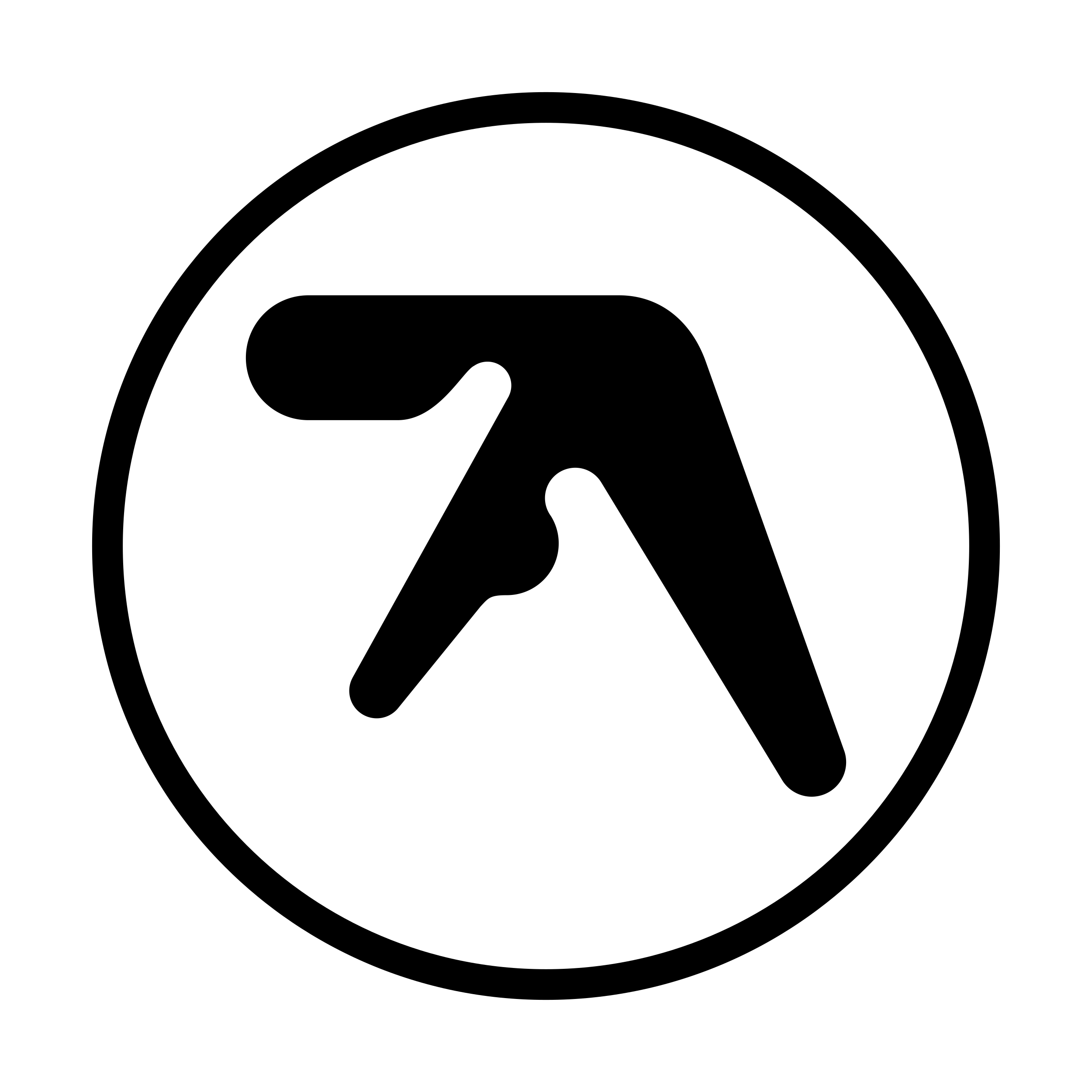
Drawn by hand.
Circle templates and rulers.
Late 1991.
Nicholson shared these construction blueprints on Instagram for the 25th anniversary of Selected Ambient Works 85–92, noting that many incorrect versions of this logo had proliferated online. The definitive construction reveals what the eye already suspects: the mark is built from overlapping circles, tangent lines, and careful radius relationships.
It is geometry pretending to be chaos. Every curve has a center point. Every transition has a reason. The logo feels organic because the math is hidden — not because the math is absent.
The logo first appeared on the sleeve of "Xylem Tube," released June 1992, and then on the cover of Selected Ambient Works 85–92 — the album that rewrote the rules of electronic music. The cover is sparse: the amorphic logo, a circle around it (Richard's idea), and two weights of Helvetica with tightened spacing. Nothing else. The restraint is the design.

Paul Nicholson. R&S Records.

Johnny Clayton. Warp Records.

Johnny Clayton. Warp Records.

The Designers Republic. Warp Records.
"We wanted it to be amorphic and soft, with no sharp lines."
— Paul Nicholson, on the Aphex Twin logo

If Nicholson gave Aphex Twin its symbol, Chris Cunningham gave it its nightmare. The "Windowlicker" video (1999) and "Come to Daddy" (1997) did something unprecedented: they pasted Richard's grinning face onto other bodies — children, women, crowds. The grin became a virus. It multiplied. It colonized every surface it touched.
Cunningham understood that the face was not a portrait but a logo in its own right — a second mark, biological where Nicholson's was geometric, but equally persistent, equally impossible to unsee.
Between the logo and the face, Aphex Twin has two visual identities operating in parallel. The logo is control — circles, rulers, precision. The face is chaos — distortion, the uncanny valley, the body as material. Together they describe the music perfectly: meticulous construction that sounds like it is disintegrating. Order that vibrates at the frequency of unease.
For most of its life, the Aphex Twin identity had no fixed color. It lived in black, in white, in whatever the sleeve demanded. Then Syro arrived in 2014 — designed by The Designers Republic — and with it came a color so specific it now belongs to Richard entirely: #C0D530. Fluoro-green-yellow. Acid. Impossible to ignore.

The logo appeared as a sticker on a receipt listing every production cost of the album — a disinfographic, a financial audit disguised as cover art. The color was the signal that Aphex Twin was back after a 13-year silence. It had to be loud.
In August 2018, the logo appeared physically in cities around the world — spray-painted on walls, embedded in fields, projected onto buildings — as a guerrilla campaign for the Collapse EP. No text. No announcement. Just the mark, alone, in contexts where it did not belong. People recognized it instantly. That is the test of a logo: does it work without its name attached? The Aphex Twin mark passes that test more convincingly than almost any identity designed in the last fifty years.
Nicholson once said the logo was meant to feel like it was moving, like a lava lamp. That motion is real — not animated, but perceptual. The curves trick the eye into seeing movement where there is none. The form breathes. It pulses. Thirty-four years after it was drawn with circle templates on a flat surface, it still looks like nothing else in music, in design, in the history of marks made by one person with a ruler and an instinct for where a line should stop.
- Paul Nicholson's logo blueprints — FACT Magazine, Feb 2017
- Aphex Twin logo analysis — Logo Design Love
- Paul Nicholson unseen artwork — Dazed Digital, Feb 2017
- SAW 85–92 typography — Fonts In Use
- "What does the Aphex Twin Logo Mean?" — Monotype
- Syro artwork reveal — The Vinyl Factory, Sep 2014
- Collapse logo installations — Dezeen, Aug 2018
- Paul Nicholson podcast — Logo Geek
- Album artwork via Wikipedia (fair use / CC BY 2.0)
- Windowlicker spectrogram — Wikimedia Commons (public domain)